 Journal Archive
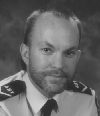
The unmistakable Scottish accent of Allan Bruce "Scottie" Scotland won't be heard any longer at the Police Department's Witness Scheduling unit. After almost 40 years as one of SA's finest, Scottie's decided that piano playing, picture framing and travel have slightly more appeal than organizing witness lists and subpoenas.
Scottie, 57, retires from SAPOL (South Australia Police) this month, but he knows that he'll miss the greatly-valued camaraderie of the police family. As the overseer of the Witness Scheduling unit's operations for the last 12 years, he's interacted with police officers throughout the entire State.
But it was strange that he ended up in a police career at all. Schooled in Latin and Greek, he was drawn to the faith and intended to become a minister. After migrating to Australia with his parents as a 16-year-old, however, he wasn't able to find a school curriculum suited to his ministerial aspirations.
He left school somewhat disenchanted with the education system and spent 18 months working for various government departments. Then, in April 1958, at the age of 18, he joined SAPOL. But to this day, he still doesn't know why he wanted to be a policeman.
Nonetheless, he describes his police career as "a happy 40 years". And, it was his time in suburban stations that he enjoyed most. "When I went to Tea Tree Gully (in 1966), it was in the outer metropolitan area, but was still semi-rural - you were part of the community, like a country copper," he says.
"You knew who your fizzes were, who your crims were and whose vehicles were what - it just all worked hand-in-glove.
"(But) you had no communication, no vehicle other than an outfit (motor cycle and sidecar), and no sergeant with you all the time. There was nobody to call on so, you were at the coalface and had to make decisions there and then."
Scottie also worked at the now defunct Thebarton and Gepps Cross police stations in the 1960s. But from early in that decade, he'd harboured an interest in the police prosecutors' role and, in 1972, joined Prosecution Services in Adelaide.
There, after working for only a few months as a prosecutor, he became an accident adjudicator. For 18 months, however, from early 1983, he turned his talents to a completely different role: managing the former SAPOL headquarters' cafeteria.
"That was very interesting: totally different from police work, and just like running your own business," he says. "But then I went back to Accident Adjudication and was offered the job in Witness Scheduling in early '87.
"I have enjoyed it. It's had its ups and downs, but I find it very interesting and, basically, I'm my own boss."
Scottie also established links with police pen pals throughout the world during his career. His correspondents came from such countries as New Zealand, Papua New Guinea, Canada, Israel, Malta, Spain, Britain and the Channel Islands. An Israeli chief superintendent in Jerusalem was one contact he not only made but also visited in 1981.
But other memories upon which he now reflects bring a hearty laugh. Jumping from a police motor cycle sidecar as a junior constable to chase a fleeing offender he'd barely seen is one such memory. Scottie was responding to his partner's cry of "Get after 'im", but knew nothing of any offence.
The offender ran from Angas Street, through the St. Aloysius convent and into Wakefield Street, where his capture was almost effected by a passing truck.
"He cut across into Divett Place," Scottie remembers. "I caught up with him, grabbed him and he fell to the ground. But I was standing there with this bloke, puffing and panting, without a copper in sight and thought, 'What the hell have I got this bloke for?' I had no idea."
When back-up patrols eventually converged on the area, Scottie learnt that his villain had just been sentenced in the Adelaide Magistrates' Court and broken away from a cell guard.
But Scottie says the initiative which he and his colleagues once used isn't a feature of modern-day policing. "I think this is one of the big things that is missing," he insists. "The young ones don't appear to be allowed to use their own initiative -- they're not allowed to think for themselves. They've got to get the sergeant in before they can do anything."
The job's unpredictability, however, is something about which Scottie takes a more philosophical line. "You could have a quiet day and have nothing happen," he explains. "Another day, you could have a couple of fatals (vehicle accidents) or a couple of bank robberies.
"It's one of those types of jobs that you just never know what's going to happen so, you've got to take the good with the bad - like any job."
But the problems of policing needn't concern Scottie any longer. He'll soon be filling his days with other interests, including a trip back to Glasgow. He's dreading his final day at work: he knows he'll succumb to emotion.
Holden Hill's Delta Social Club will become his means of keeping in touch with former workmates. But how does Scottie want to be remembered by those workmates?
"I'd like (them) to think that I'd done my part in helping as much as I possibly could, especially in the job that I've been doing in Witness Scheduling," he says. "It hasn't been easy, but I've had the satisfaction of being able to help them."
[End]